
Tatami — The Floor That Teaches Us How to Sit
We tend to overlook the true essence of Tatami, viewing it merely as a traditional flooring material. If a wooden floor is a "surface to place your feet," then Tatami is a "place to settle your heart and body."
In modern Japan, the number of Tatami rooms is decreasing. Many people now live on cold, hard flooring. Yet, to talk about Japan without mentioning Tatami is to miss the very foundation of its culture. Historically, the Japanese lived their entire lives upon Tatami. They ate, conversed, slept, and meditated there. Throughout all these actions, Tatami has remained a silent guardian—shaping our posture, defining our distance from others, and anchoring the stillness of a room.
Contents
- A Teacher of Posture
- The Architecture of "Sitting"
- Designing Distance and "Ma"
- The Breath of Silence
- The Spirit of Restoration: Tatami and Time
- Bringing "Fragments of Stillness" Into Daily Life
- Where Will You Face Yourself?
A Teacher of Posture
When one sits on Tatami, there is an unconscious urge to straighten the spine. It possesses a unique elasticity—neither as hard as wood nor as soft as a sofa. The microscopic weave of the Igusa (rush grass) sends a quiet message through your knees and the soles of your feet, asking: Where is your center of gravity right now?
To "sit correctly" is to govern oneself. Tatami does not force; it simply reminds us of our ideal form through the honesty of its texture. This relationship with the floor has shaped the Japanese sense of dignity for centuries.
The Architecture of "Sitting"
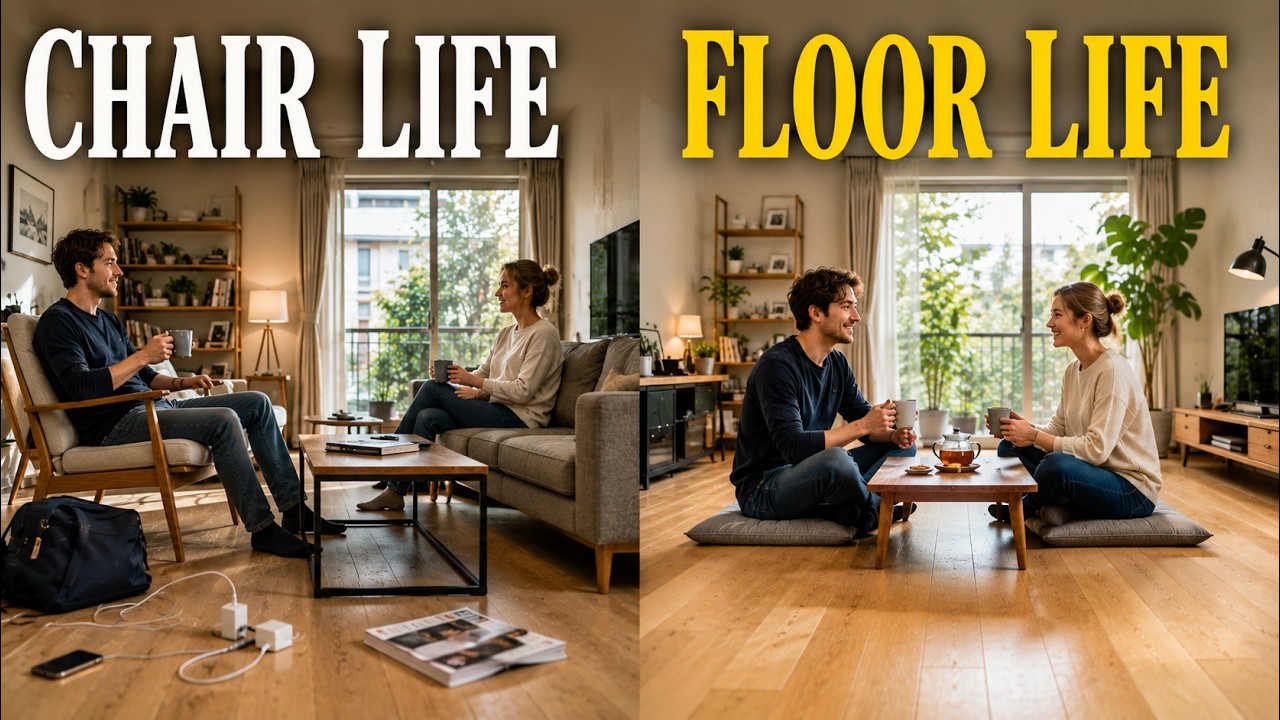
In Western architecture, furniture determines the function of a room. A bed makes a bedroom; a dining table makes a dining room. However, a Tatami room is versatile because it is empty. By simply laying out a futon, it becomes a place to sleep. By placing a low table, it becomes a place to gather.
This flexibility comes from the floor itself. Tatami is soft enough to sleep on, yet firm enough to work on. It is an "all-in-one" platform for life. When we sit directly on the floor, our perspective changes. We become closer to the earth, and the ceiling feels higher. This lower center of gravity creates a sense of psychological stability that is difficult to find in a chair-based lifestyle.
Designing Distance and "Ma"
The weave and the Heri (borders) of a Tatami mat act as invisible boundaries within a space. The units of Ichijo (one mat) or Hanjo (half mat) create a deliberate geometry. By being aware of these edges, we have long recognized our own place and shown respect for the space occupied by others.
The concept of "Ma" (the meaningful void)—often lost in the vastness of modern open-plan living—still breathes upon the Tatami. It dictates a natural, respectful distance that fosters deeper connection. In a tea room, for example, the position of each mat tells you exactly where to sit and how to move. It is a silent language of space.
The Breath of Silence
The moment you enter a room with Tatami, you are greeted by its scent. The fragrance of Igusa reaches deep into the lungs, calming the nervous system. This is not just a pleasant smell; it is a functional one. Igusa has natural air-purifying qualities and regulates humidity, making the room feel "alive."
Furthermore, Tatami swallows sound. Footsteps, voices, and the external clamor of the world are gently absorbed by the layers of straw and grass. It doesn't just block noise; it settles it. In this stillness, perhaps for the first time, one can truly hear the voice within.
The Spirit of Restoration: Tatami and Time
Like many traditional Japanese objects, Tatami is not meant to be permanent, yet it is designed to last. As years pass, the green grass turns into a beautiful golden straw color. This change is not seen as "aging" in a negative sense, but as a maturation—a record of the time spent in that home.
When the surface becomes worn, it can be "flipped" or replaced without discarding the entire structure. This cycle of maintenance reflects the Japanese value of Mottainai (respect for resources). It is a floor that breathes with the inhabitants, evolving alongside them.
Bringing "Fragments of Stillness" Into Daily Life
Integrating the culture of Tatami into a modern home does not necessarily require a full architectural renovation. Even in a modern apartment, you can invite this essence into your life through simple additions.
If one were to commission a Traditional Full-Sized Tatami Mat, the cost generally starts around 15,000 to 30,000 JPY, depending on the quality of the materials. It is a long-term investment in a handcrafted tradition that supports your life for decades.
For those looking to add a "space for reflection" to a modern interior, Simple Igusa Mats or Unit Tatami offer a more accessible entry point:
- Igusa Rugs/Mats (approx. 180cm x 180cm): Roughly 5,000 to 12,000 JPY
- Unit Tatami (Single square tile): Roughly 3,000 to 8,000 JPY
Note: These are standard price ranges within Japan. They serve as a guide for those wishing to sense the authentic atmosphere of a Japanese home.
Where Will You Face Yourself?
Tatami offers no direct answers. It simply waits. How you breathe and what words you choose to speak while sitting there is entirely up to you. It is more than just flooring; it is a ritual of daily life that asks us to slow down and be present.
In the rush of modern life, try pausing to entrust your weight to the floor. In that moment, what kind of landscape will unfold within your mind? Perhaps, in the silence of the grass, you will find a part of yourself that you had forgotten.
Next Article
Objects That Think — What Japanese Tools Teach Us About Living
The final article in our March series reflects on the tools we have explored this month. What do they collectively teach us about the rhythm of daily life and the intention behind the things we own?
→ Next in the series: Objects That Think — What Japanese Tools Teach Us About Living
March Series: Objects That Carry Intention
- 3/2 Wa-Bocho — Why Japanese Knives Are Made to Reveal, Not Conquer
- 3/7 Cutting Without Violence — The Japanese Way of Precision
- 3/11 Why Japanese People Purify Before They Enter
- 3/16 Spring in Japan Is About Preparing, Not Blooming
- 3/21 Why Japanese Things Are Repaired, Not Replaced
- 3/25 Tatami — The Floor That Teaches Us How to Sit(this article)
- 3/30 Objects That Think — What Japanese Tools Teach Us About Living
Follow the full series to see how everyday Japanese tools carry deeper cultural ideas.
Related Learning Blog
If you're curious about how Japanese meaning works beyond translation, our companion learning blog explores the language side of Japanese culture.
If you want more glimpses of how Japanese tools and everyday spaces carry intention, follow the series and save this post for later.



 Posts
Posts


No comments:
Post a Comment